A Rainy Afternoon, Five Found Colours
A rainy afternoon colour hunt helps you build a small, personal palette from indoor objects, with a simple routine for noticing and recording each shade.
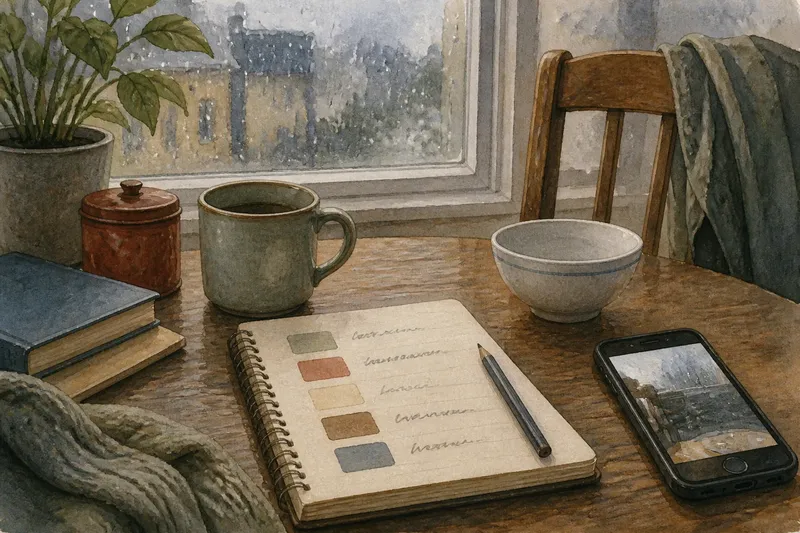
The common mistake in a rainy afternoon colour hunt is to begin by searching for striking colours. That can turn a relaxed hour indoors into a hunt for objects that are not there, and leave you with a palette chosen for brightness rather than attention. Start instead with what is already in view: a mug, a book spine, a damp-looking coat or the grey light resting on a windowsill.
The aim is to notice five colours in ordinary surroundings and keep a small record of them. No paints, swatches or special equipment are needed. A phone camera, a scrap of paper and a pencil are enough, though you can do the whole activity by looking and remembering.
What should you gather before the rain settles in?
Choose a spot where you can sit comfortably and see several different kinds of things: perhaps a kitchen table, a hallway or a chair near a window. Keep the view broad enough to include objects, surfaces and changing light, but do not arrange anything for effect. The point is to find colour where it already lives.
Have a few simple tools within reach:
- A notebook or scrap paper for short colour notes.
- A pencil or pen to record names and locations.
- A phone camera, if you want a visual reminder rather than a precise colour sample.
- A timer, optional, to give each viewing period a gentle boundary.
Use these as aids, not as a requirement. A camera can shift colour because of exposure and screen settings, so treat a photograph as a memory cue, not an exact match. Avoid moving fragile, hot or awkward objects just to improve the view.
How can you make the hunt fit one rainy afternoon?
Give the activity a loose rhythm: look, pause, return. This keeps the afternoon open to changes in the weather without making the hunt feel like a task list. If the rain stops, the light may change; if it continues, the room may become dimmer. Either way, those shifts are part of what you are observing.
When should you choose the first colour?
Begin with a quiet look around the room before writing anything down. Let your eyes rest on one object or patch of light that you might usually pass without noticing. Name its colour in plain language, such as “soft green” or “warm grey”, then note where you saw it.
Say you are seated at a kitchen table and notice a blue-grey shadow beneath a white bowl. Write “blue-grey, under the bowl” rather than trying to find a perfect colour term. The note records what caught your attention and where it appeared.
What should you do after the first look?
Take a short pause and look again from the same seat. Seek a colour that differs in character, not necessarily one that contrasts sharply: a dull red label, a yellowed page or the brown grain of a wooden chair might be enough. Add a second note, then leave the scene alone for a while.
How do you notice colour changing with the weather?
Later in the afternoon, return to the same view and check whether the light has altered how a familiar surface appears. A pale wall may look cooler as daylight fades, while a coloured fabric may seem less vivid. Record the change in a few words, keeping the object and the moment together in your note.
When is the palette complete?
Stop when you have five observations that feel distinct to you, even if several are muted or close in tone. The five do not need to represent the whole room; they only need to make a small record of this particular afternoon. If you have more, keep the extras separately rather than forcing them into the main group.
How do you choose five colours without turning it into a contest?
It helps to give each colour a different kind of source. You might look for one colour on a useful object, one in a printed surface, one in a natural material, one in a shadow and one in a reflection. These are prompts, not quotas. If a source is absent, choose something else that draws your eye.
For example, a household view might offer the muted green of a plant leaf, the rust red of a tin, cream paper, charcoal beneath a chair and a pale reflection on a glass. The colours are not selected because they form a polished design scheme; they belong together because they were noticed in one room during one stretch of weather.
Try describing each entry with two parts: a colour word and a location. “Brown” is broad; “brown in the chair’s worn arm” gives the memory a place to return to. If a shade is hard to name, describe its quality instead: dusty, clear, warm, cool, dull or bright.
What can you do with the notes once the rain eases?
Put the five observations in a row on the page, leaving a little space between them. You can add small pencil marks, simple coloured shapes or quick sketches of the objects. If you use a phone image, keep the subject in frame and avoid editing it to make the colours more vivid.
Read the list once and notice what the colours have in common. Perhaps several appear on worn surfaces, or the palette contains more greys than you expected. You do not need to correct that balance. The useful result is a record of what the room offered and what your attention selected.
If you want to continue, revisit the same notes on another rainy day and add a new set beside them. Keep the first set intact so the two afternoons remain distinct. This is a simple way to see how a familiar room can offer different colour cues without buying materials or rearranging its contents.
How can you make the colour hunt easier to return to?
Keep the record small enough that you can repeat it without preparing. A folded page tucked into a notebook, or a note saved with a clear title, is plenty. Write the date only if it helps you distinguish one viewing from another; the weather and location may be more useful details.
A rainy afternoon colour hunt works best as an invitation to look again, not a test of colour knowledge. Use the words that come naturally, leave uncertain shades unnamed if necessary, and let the room remain as it is. The next time rain softens the light, your old notes can point your attention towards a fresh colour you had not noticed before.