Wax Rubbing for Texture Study: Reading the Marks Contact Leaves
Wax rubbing for texture study helps you notice how paper, pressure and stroke direction shape a mark, while keeping the surface itself in view.
The common mistake with wax rubbing for texture study is to treat the sheet as a faithful picture of the object beneath it. That can lead you to mistake a pressure mark for a groove or miss what the paper could not reach. Read the rubbing as a record of contact: the tool, paper, hand and surface all contribute to what appears.
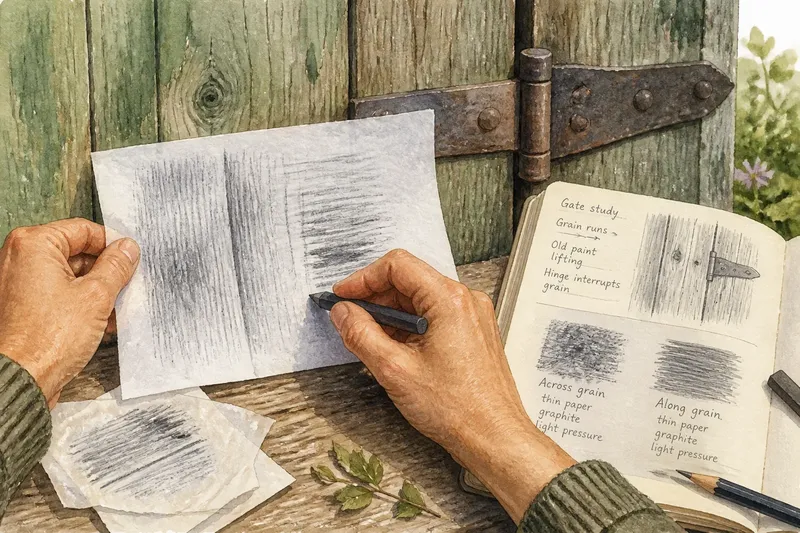
Imagine Mara, an invented maker, studying the worn grain of an old wooden garden gate. She has thin paper, a soft graphite stick and a notebook. She wants to learn what her materials register, then check those marks against the gate rather than treating the rubbing as a copy.
What does wax rubbing record?
In a rubbing, paper rests against a textured surface while a drawing tool passes over it. Pigment catches more strongly in some places than others, making ridges, edges or interruptions easier to notice. The result depends on how the materials meet; it is not a neutral transfer of the surface.
The method belongs to a broader family of contact techniques. Rubbings have been used to make carved lettering and patterns easier to inspect on a flat sheet, while impression methods such as pressing clay into a texture record relief in a different way. These methods share an interest in contact, but the trace each makes depends on the material and action involved.
For Mara, the useful question is not whether her rubbing looks like the gate. She first looks from several angles and notes the grain’s direction, lifted paint and the interruptions made by the hinges. That direct observation gives her a reference for reading the marks later.
How do paper, pigment and pressure change the mark?
A soft graphite stick can leave broad, smoky marks; a wax crayon may leave a denser line. Thin paper can meet small variations, but it may crease or tear. Heavier paper can bridge shallow dips and produce a simpler pattern.
Stroke direction also matters. Strokes across a grain may make ridges stand out, while strokes along it can merge with existing lines. Uneven pressure can darken one patch even when the surface itself has no corresponding change.
Mara’s first sheet shows a dramatic dark stripe. She checks the board and sees that the stripe follows her repeated strokes rather than a deep groove. She labels it “pressure mark” in her notes instead of attributing it to the wood.
When a mark looks unusually strong, check your hand and tool before drawing a conclusion about the object.
How can you make a careful rubbing?
Choose a surface you can examine without moving it or causing damage. Do not rub fragile, painted or culturally significant material unless you have permission and know that contact is appropriate. If permission or suitability is uncertain, make a drawing or photograph instead, following any rules for the place.
Mara first sketches a small area of the gate and marks the grain’s direction. She lays thin paper against the surface, holds it at the edges and uses the side of her graphite stick for a few gentle strokes in one direction. She checks the sheet, then uses a fresh patch of paper for strokes in a crossing direction. Keeping the rubbings separate lets her see how direction changes the result.
She does not press harder to force a clearer image. If a feature does not register, she notes that the method did not capture it rather than scraping or wedging the paper into the surface. Afterwards, she records the paper, tool, stroke direction and pressure in her notebook.
Say Mara writes “thin paper, graphite, across grain, light pressure” beside her first sheet. She can then compare it with the crossing-stroke sheet and ask whether a line changes with her direction. If it does, she treats that line cautiously; if it remains visible in both, she checks the gate directly before deciding what it might indicate.
What can a texture rubbing tell you—and what can’t it?
A rubbing can make repetition, orientation and contrast easier to notice. It may show where texture changes across a small area or how a material responds to ridges and hollows. It cannot reliably show a groove’s depth, preserve the surface’s original colour or explain what caused every mark.
A dark streak might come from a groove, roughness, a paper crease or the maker’s hand. A pale patch might be smooth rather than recessed. Look back at the object and compare the rubbing with a sketch or notes before naming what a mark means.
Mara’s crossing strokes reveal a repeated grain that was hard to see on her first sheet. A pale patch appears in both rubbings, but her sketch shows that paint remains there and the area is smooth. She records the difference without calling it a hollow.
Which questions help you read a rubbing?
Why do two rubbings of the same surface look different?
Paper, pigment, pressure and stroke direction shape the mark. A feature may become darker, softer or absent when one of those conditions changes, even though the object stays the same.
Does a rubbing show the depth of a groove?
Not reliably: it may show an edge or a change in pigment where paper settles into a groove, but the flat sheet does not preserve depth. Check the surface directly if depth matters to your observation.
Can I use something other than graphite?
Yes. Wax crayon, charcoal and soft pastel make different marks, while clay or another impression material can record relief through pressure. Choose a material suited to the surface and avoid contact that might damage it.
What should I write beside a rubbing?
Note the paper, tool, stroke direction, pressure and visible interruptions such as seams or edges. These details help you distinguish what you observed from what your technique contributed.
What should you check before interpreting a mark?
- If a dark line follows your strokes, then note the stroke direction and make a gentler rubbing on fresh paper; if it remains, compare it with the object, otherwise treat it as a likely pressure effect.
- If a pale area appears, then look directly at the surface for smoothness, paint or a hollow; if it is smooth or painted, record that, otherwise describe it as uncertain rather than calling it a recess.
- If paper creases or tears, then stop and inspect the sheet; if the mark follows the crease, set it aside and use fresh paper, otherwise record the damage as a limit on the impression.
- If strokes along the grain merge with its lines, then use a separate sheet for strokes across the grain; if the pattern becomes clearer, note the directional effect, otherwise rely on direct observation.
- If the surface is fragile, painted or culturally significant, then check permission and suitability before contact; if either is unclear, do not rub it and make a drawing or permitted photograph instead.
- If a feature does not appear on the sheet, then check the source and note the omission; if the feature is visible there, keep it in your sketch, otherwise leave the rubbing inconclusive.
How does study differ from copying?
Study asks what a method makes visible and what it leaves out; copying aims to resemble the source. Mara keeps her sketch beside the two rubbings. The sketch preserves colour and the larger arrangement, while the sheets show how different stroke directions interact with the grain.
Her caption reads: “The grain repeats in bands; the dark stripe on the first sheet follows my hand.” It separates what she can see from what she infers, and gives another reader enough context to understand how the rubbing was made.
Wax rubbing for texture study works best when you keep the trace beside a record of its making. Save the sheet, note the tool and direction, and check uncertain marks against the surface; that way, the rubbing remains useful without being mistaken for the object itself.